This installment is going to be about nutri... WAIT! I can't even spell that word without laughing a little! Those of you who know me well, know that nutrition really isn't my thing! I mean, one of my beliefs is there simply is NOT enough restaurants with tater tots on the menu, and I don't eat fruit, except for olives and peppers! So, I'm not going to pretend to be a nutritionist and tell you what to eat. I will, however, share a couple of things I learned while training for this marathon.
The first is a no brainer! YOU HAVE TO EAT! What I mean by that, is I think dieting while training for a marathon is not the best idea. Calories are energy, and when you're burning a few hundred every run, you have to replenish. Now, how you do so, is totally up to you, but try to do so within a couple of hours. The quicker you can get those carbs, fats and proteins back into your system, the quicker those fatigued muscles can recover! My method, a recovery drink like GU Brew Recovery that will absorb into those cells quickly, and then, for whatever reason, I crave a good burger, especially after a long run!
While I'm on the subject of long runs, it's obvious long runs are on the training schedule to get your legs, body and mind ready for the big day, but remember, they are also on the schedule to help develop a nutrition plan. This part is something I have never done properly, until now! In the past, during a long run or bike ride, I'd just take a GU when I felt like I needed it, but what I didn't realize was by the time I felt like I needed it, I was too late. The dreaded bonk had already started and there was no coming back! There were three things I focused on before race day. 1. The night before, 2. The morning of, and 3. During the race.
1. The night before. You've heard it a million times! CARBO LOAD! While I think carbo loading isn't a bad idea, I think a balanced diet is a great idea. If you can stick to a 40-30-30 diet plan or something similar, you're probably "carbed" up. I suggest picking something, maybe a favorite, low in fiber, not too heavy, and low on the grease or oil. Most importantly, don't over do it! My first college coach had a saying. "Stuffed is Stupid!" I had to learn this the hard way during this training block. Let's just say, I was wearing a $60 pair of socks that morning, and I lost one!
2. The morning of. I don't know about you, but I HATE getting hungry during a long run! So, it only makes sense to me that you have to eat something to try curb your hunger. During training, I tried to eat granola bars and/or GU Chomps before the run, but both were not substantial enough to keep me full for a two and a half hour to three hour run. For race day, I decided to, DUM, DUM, DUM!!!, break the first rule of marathoning and do something different on race day! I had a bagel with peanut butter about an hour an a half before the start! I am so happy I did!! I didn't get hungry throughout the race, and I think just that small "meal" helped keep me from getting sluggish toward the end!
3. During the race!! I needed the most help with this one!! So, what did I do, as I mentioned in the previous post, I used my resources! I started asking customers, fellow runners on training runs, and some local coaches what they do during the race. I knew I was going to use GU, since that was what I had practiced with and used for years, but I wasn't sure how many and when. I first figured I was going to be out there no longer than three hours and fifteen minutes, finger crossed! I then figured that after an hour and a half, that glycogen storage may be tapped and muscles may start to burn other things producing lactic acid and causing fatigue. Lastly, GU's website recommends using one every 30 to 45 minutes. I came up with the plan to take one at 1:15 to be in my system before 1:30, another at 2:00 and the last one at 2:30 to hopefully get me to the finish! The plan worked like a charm!
I'll sum up with this! I think it's a good idea to treat every long run as a dress rehearsal! You have to be aware of how your body responds to when you eat, what you eat, and how you sustain energy throughout the run with GU or whatever you choose to use! A proper training program gives you time to figure it all out, so experiment and use what you discover to develop a plan!
Thursday, November 13, 2014


Tuesday, October 28, 2014
MARATHON (MY plan)
So, you want to run a marathon!
Where to begin?
Well, I think step 1 is to begin with a plan! Ordinarily, I would say step 1 is to get get fit for your most important piece of equipment, a pair of shoes, by the best running specialty store in town, i.e. The Trak Shak, but I'm assuming if you're considering running a marathon, you're seasoned a bit and have already made this wise decision. (Note, I will obviously be talking about shoes in future installments of this marathon blog.)
So, back to The Plan! There are many, many things to consider when choosing a marathon training plan. You must consider your running background, your goals for this distance, your lifestyle, and the conditions under which you'll be training. There are also many, many generic and successful plans you can find by clicking on a link embedded in a marathon website. For instance, check out the Mercedes Marathon training program here! If your goal is to simply "GET TO THE FINISH LINE" follow this plan to a T, and it will get you there! There are also a multitude of other plans on major marathon websites that can help you achieve time goals and even get you to a Boston qualifier! My plan? Well, let's just say it was a bit more "fluid"!
It all started with a friend and fellow Trak Shak'er, Q, and me deciding to train for a marathon in 2014. We threw a couple of races around and came up with 7 Bridges in October. The decision was made about 22 weeks out from race day. Most training programs you see are around 20 weeks, thus my first snafu! Most of my training "blocks" in college were around 10 weeks! This meant 10 weeks of focus and very hard training centered around a goal race. TWENTY WEEKS sounds like an eternity! So, I did what I think all aspiring marathoners, half marathoners, 10K'ers, and 5K'ers should do, I USED MY RESOURCES! When you hear the term resources now-a-days, the first thought in everyone's mind is the internet, but when you live in such an awesome running community, like Birmingham, with magnificent coaches, an unbelievable track club, running Mecca like The Trak Shak, and dozens of accomplished marathoners running and training every day, you shouldn't surf any further. I am extra lucky to work in "Mecca" with college coaches, Boston qualifiers, everyday runners, and my old coach, who just so happens to be an Olympic Trials Marathon qualifier! So, I asked the old coach, Scott, what do you think about me training for a marathon in October? His first response, "How many weeks?". When I say 22, he automatically, knowing all of the aforementioned criteria and most importantly, ME, says "It's too long." These simple words of advice meant so much for me and my plan!
OK! Finally! MY PLAN! Considering the factors I mentioned in the second paragraph. My running background: I ran in college, have run a bit since, have trained for and attempted one marathon, unsuccessfully, and have had a long laundry list of lower leg running injuries. My goals for the marathon: honestly, to finish! My lifestyle: I work full time, have a beautiful family, travel some, run regularly, and like beer. The conditions under which I would be training: A FREAKING, ALABAMA SUMMER!
The first 10 weeks were focused on two things, strength and consistency, AND there was no thought of the marathon. I wanted to keep my mileage around 40 miles per week, with one hard work out, mainly hills, and one long run no longer than an hour and twenty minutes. It seems pretty straight forward and maybe to a few, rather conservative. The main goal was to stay healthy! I basically committed to a 12 week marathon program!
The first 10 weeks, CHECK! Consistent and healthy! Now, down to the nitty-gritty! Two main focuses during this last 12 week block, the long run and the workout. Considering my struggles with the heat and humidity of the Summer, I decided to focus more on time with my long runs, rather than distance. I knew I was going to have to adjust my pace considering the humidity, so I didn't "sweat" the distance. If I was going for an hour and 40 minute run and only got in 12 miles, so be it! The long runs were to start at an hour and a half and increase by 10 minutes each week. That would have gotten me to a 3 hour long run, 3 weeks from the marathon. PERFECT! Or so I thought! About 7 weeks out, my wife and new head coach, said, you may want to think about picking it up a bit, and she was right! While focusing on time rather than distance helped me slow it down a bit, struggle through some soupy conditions and not force mileage, it was really holding me back from getting in those 18 & 20 milers that are necessary for the marathon. Luckily, the weather started to cooperate a bit and I was able to nail down two 18 milers, a 20 miler and a "sufferfest" of a 22 miler!
The one workout a week shifted from the early hill repeats to intervals. I knew I needed to do some longer intervals, and was really dreading it! Why? The first workout of cross country season, after returning from Summer break was MILE REPEATS! I dreaded that workout every year! The first was 4 x mile at 1 minute faster than easy run pace, so 6 minute pace. I nailed the first workout and that boosted by confidence! The next three weeks were 5 x mile, 6 x mile and 6 x mile. During the last workout, I tweaked my calf a bit, and knew from past bad experiences with calf issues, I had to change something. This is where age really helps! I actually listened to my body and shifted my workouts from repeats to more tempos. That next week I hit a 5 mile tempo at just over 6 minute pace, and what do ya know, no calf issues! The tempos increased to my final workout before the marathon, a 12 miler with 10 miles at just under race pace. Those 10 miles were all around 6:40's.
FINALLY! The taper! When I was younger, I hated the taper! You go from this intense routine of not missing runs or workouts, moving your schedule around to make sure you fit in your long run, trying to get in bed early, and focusing on hydration, to BACK OFF! BUT man I was craving the taper, and I took advantage. If the schedule said 8 miles, I did 5 or 6. My last "long run" was a 13 miler two weeks before and then after that, there wasn't a run longer than 6. I really felt fresh come race day.
Well, I may have gotten a bit long winded with this post! I think my reasoning and point of sharing this plan is to relay to our customers and followers, while you HAVE to have a plan, it's very important to listen to your body and adapt accordingly! If I would have followed a 20 week, intense workout plan, I would have ended up on the injured reserve, looking to do Rocket City in December! While my mileage wasn't really high, and my workouts weren't overly intense, I was very pleased to have reached my training goal, which was simply to make it through healthy, because what's the point if you can't make it to the start line?!!
OK! What's next? Another opportunity for me to get long winded!!! 22 weeks and over a dozen pairs of shoes to mention!! Stay tuned!
Where to begin?
Well, I think step 1 is to begin with a plan! Ordinarily, I would say step 1 is to get get fit for your most important piece of equipment, a pair of shoes, by the best running specialty store in town, i.e. The Trak Shak, but I'm assuming if you're considering running a marathon, you're seasoned a bit and have already made this wise decision. (Note, I will obviously be talking about shoes in future installments of this marathon blog.)
So, back to The Plan! There are many, many things to consider when choosing a marathon training plan. You must consider your running background, your goals for this distance, your lifestyle, and the conditions under which you'll be training. There are also many, many generic and successful plans you can find by clicking on a link embedded in a marathon website. For instance, check out the Mercedes Marathon training program here! If your goal is to simply "GET TO THE FINISH LINE" follow this plan to a T, and it will get you there! There are also a multitude of other plans on major marathon websites that can help you achieve time goals and even get you to a Boston qualifier! My plan? Well, let's just say it was a bit more "fluid"!
It all started with a friend and fellow Trak Shak'er, Q, and me deciding to train for a marathon in 2014. We threw a couple of races around and came up with 7 Bridges in October. The decision was made about 22 weeks out from race day. Most training programs you see are around 20 weeks, thus my first snafu! Most of my training "blocks" in college were around 10 weeks! This meant 10 weeks of focus and very hard training centered around a goal race. TWENTY WEEKS sounds like an eternity! So, I did what I think all aspiring marathoners, half marathoners, 10K'ers, and 5K'ers should do, I USED MY RESOURCES! When you hear the term resources now-a-days, the first thought in everyone's mind is the internet, but when you live in such an awesome running community, like Birmingham, with magnificent coaches, an unbelievable track club, running Mecca like The Trak Shak, and dozens of accomplished marathoners running and training every day, you shouldn't surf any further. I am extra lucky to work in "Mecca" with college coaches, Boston qualifiers, everyday runners, and my old coach, who just so happens to be an Olympic Trials Marathon qualifier! So, I asked the old coach, Scott, what do you think about me training for a marathon in October? His first response, "How many weeks?". When I say 22, he automatically, knowing all of the aforementioned criteria and most importantly, ME, says "It's too long." These simple words of advice meant so much for me and my plan!
OK! Finally! MY PLAN! Considering the factors I mentioned in the second paragraph. My running background: I ran in college, have run a bit since, have trained for and attempted one marathon, unsuccessfully, and have had a long laundry list of lower leg running injuries. My goals for the marathon: honestly, to finish! My lifestyle: I work full time, have a beautiful family, travel some, run regularly, and like beer. The conditions under which I would be training: A FREAKING, ALABAMA SUMMER!
The first 10 weeks were focused on two things, strength and consistency, AND there was no thought of the marathon. I wanted to keep my mileage around 40 miles per week, with one hard work out, mainly hills, and one long run no longer than an hour and twenty minutes. It seems pretty straight forward and maybe to a few, rather conservative. The main goal was to stay healthy! I basically committed to a 12 week marathon program!
The first 10 weeks, CHECK! Consistent and healthy! Now, down to the nitty-gritty! Two main focuses during this last 12 week block, the long run and the workout. Considering my struggles with the heat and humidity of the Summer, I decided to focus more on time with my long runs, rather than distance. I knew I was going to have to adjust my pace considering the humidity, so I didn't "sweat" the distance. If I was going for an hour and 40 minute run and only got in 12 miles, so be it! The long runs were to start at an hour and a half and increase by 10 minutes each week. That would have gotten me to a 3 hour long run, 3 weeks from the marathon. PERFECT! Or so I thought! About 7 weeks out, my wife and new head coach, said, you may want to think about picking it up a bit, and she was right! While focusing on time rather than distance helped me slow it down a bit, struggle through some soupy conditions and not force mileage, it was really holding me back from getting in those 18 & 20 milers that are necessary for the marathon. Luckily, the weather started to cooperate a bit and I was able to nail down two 18 milers, a 20 miler and a "sufferfest" of a 22 miler!
The one workout a week shifted from the early hill repeats to intervals. I knew I needed to do some longer intervals, and was really dreading it! Why? The first workout of cross country season, after returning from Summer break was MILE REPEATS! I dreaded that workout every year! The first was 4 x mile at 1 minute faster than easy run pace, so 6 minute pace. I nailed the first workout and that boosted by confidence! The next three weeks were 5 x mile, 6 x mile and 6 x mile. During the last workout, I tweaked my calf a bit, and knew from past bad experiences with calf issues, I had to change something. This is where age really helps! I actually listened to my body and shifted my workouts from repeats to more tempos. That next week I hit a 5 mile tempo at just over 6 minute pace, and what do ya know, no calf issues! The tempos increased to my final workout before the marathon, a 12 miler with 10 miles at just under race pace. Those 10 miles were all around 6:40's.
FINALLY! The taper! When I was younger, I hated the taper! You go from this intense routine of not missing runs or workouts, moving your schedule around to make sure you fit in your long run, trying to get in bed early, and focusing on hydration, to BACK OFF! BUT man I was craving the taper, and I took advantage. If the schedule said 8 miles, I did 5 or 6. My last "long run" was a 13 miler two weeks before and then after that, there wasn't a run longer than 6. I really felt fresh come race day.
Well, I may have gotten a bit long winded with this post! I think my reasoning and point of sharing this plan is to relay to our customers and followers, while you HAVE to have a plan, it's very important to listen to your body and adapt accordingly! If I would have followed a 20 week, intense workout plan, I would have ended up on the injured reserve, looking to do Rocket City in December! While my mileage wasn't really high, and my workouts weren't overly intense, I was very pleased to have reached my training goal, which was simply to make it through healthy, because what's the point if you can't make it to the start line?!!
OK! What's next? Another opportunity for me to get long winded!!! 22 weeks and over a dozen pairs of shoes to mention!! Stay tuned!
Wednesday, October 22, 2014
MARATHON (in retrospect)
Well, I DID IT!!! It's been a LONG time coming, but I finally marked "Finish a Marathon" off my bucket list! I had all intentions of posting throughout my training, but then two thoughts occurred to me! First, while the training was difficult in the hellish Summer, I was healthy, and call me superstitious, I didn't want to jinx it! Second, while I have known the fundamentals and basics of training for a marathon for a LONG time and have been lending my advice to our customers for almost 20 years, I had a bit of a struggle with my confidence during this training block and thought maybe I should finish one of these things before I start posting "my" training tips! So, here I am, a marathoner, as one of my friends put it in a text on Sunday, and here's my blog plan! I'm going to start with a commentary in this entry and then follow up with a "series" of my learning experience, because training for and racing 7 Bridges Marathon was NOTHING if it wasn't a learning experience!

The race started at 7 AM, which on the western border of the Eastern Time Zone, means DARKNESS! The temperature was around 50 and the humidity, while we were right next to the river, was surprisingly low. Everyone gathered in Coolidge Park, which as I mentioned, is right next to the river with the John Ross Bridge overshadowing. I'll be honest, I had no idea how I was going to feel and how the race was going to go!! My training over the prior 3 weeks went pretty piss poor. OH, and did I mention I had never run that distance before! The only confidence I had was in the plan I had come up with. Every single marathoner I talked to leading up to this race warned me NOT to go out too fast, so the plan was to go out around 7:15's to 7:20's through at least 10 and hopefully, gradually increase the pace to the finish!
The race started, and man, I have to say, race day really makes your legs feel good!! The adrenaline! The crowd! That bib on your shirt! It all adds up to making it really, REALLY hard to hold yourself back and stick to your plan! BUT, I did it! I held that comfortable pace through 12, averaging just over 7:10's. Now, this next part, you may have read about on Facebook or noticed if you just so happened to look at the results. Miles 8 through 11.5 are on the Tennessee Riverwalk. Just after mile 12, you are supposed to exit the Riverwalk through a parking lot and take a right to the next bridge. Well, I did that, and I believe I may have been the first person to do so. The leaders kept following the Riverwalk and ran the course backwards. When I crossed paths with them at mile 15, I began to wonder how the race directors were going to handle the situation. I know most of the rules and understand the reason for time checks on a course. As of now, I am listed as the overall winner, but I know I don't deserve it. I hope this can somehow be resolved!
Back to the race!! At mile 13 is when my gradual progression run began. The pace comfortably dropped, each mile faster than the previous by a few seconds, except for the 16th mile which was a steady uphill bridge for what seemed like forever! The progression continued on 18 through 22, going from 6:45 to 6:37. I looked at my watch with 4.2 to go, had 31 minutes til 3 hours and thought, "Oh, I've got sub-3!!"!! Then mile 23 happened! My right groin cramped just before a water stop. I couldn't believe it! I felt so good to that point! My first thought was to try to run through it, but since the water stop was right there, I decided to walk through and drink some Powerade. When I started back up, I again gradually picked up my pace paying close attention to my groin. Then, at mile 25, my left hammy cramped, and I knew sub-3 was gone. I wisely walked through another water stop, taking some Powerade, took it really slow up the final climb, and jogged it in to a smooth 3:05, which won me 1st Place Master (HA!), NOT 1st Overall!

Back to the race!! At mile 13 is when my gradual progression run began. The pace comfortably dropped, each mile faster than the previous by a few seconds, except for the 16th mile which was a steady uphill bridge for what seemed like forever! The progression continued on 18 through 22, going from 6:45 to 6:37. I looked at my watch with 4.2 to go, had 31 minutes til 3 hours and thought, "Oh, I've got sub-3!!"!! Then mile 23 happened! My right groin cramped just before a water stop. I couldn't believe it! I felt so good to that point! My first thought was to try to run through it, but since the water stop was right there, I decided to walk through and drink some Powerade. When I started back up, I again gradually picked up my pace paying close attention to my groin. Then, at mile 25, my left hammy cramped, and I knew sub-3 was gone. I wisely walked through another water stop, taking some Powerade, took it really slow up the final climb, and jogged it in to a smooth 3:05, which won me 1st Place Master (HA!), NOT 1st Overall!
Going back to what I said in the beginning, I had no idea what to expect! I've heard countless stories of first marathon experiences! There are two things I was extremely surprised by. One, I can NOT believe how good I felt at 20 miles! I kept waiting for the same sluggishness that developed in my 22 mile long run to creep up on me, and it never did! I chalk that up to a proper taper. Two, to answer the age old question, will I run another? I am completely surprised my answer is a resounding YES! I mean, I have to run Boston, right?
So, lessons learned! Keep an eye on the blog for some installments about training, shoes, nutrition, and race weekend. I can finally properly lend such advice!
FINALLY! I have to mention a key reason for such a great first marathon experience! My wife Lena and Mom, Shelia! Man, they took care of everything! From travel, reservations, restaurant, OUR KIDS!! I literally only had to worry about getting my ass to the finish line! It was HUGE! THANK YOU! THANK YOU! THANK YOU!
Thursday, August 21, 2014
Our FIRST "Guest" blog entry!
Used and Abused
By Scott Strand
At The
Trak Shak Running Shops, I’ve taken pride in over 17 years of full-time service
to the runners and walkers in the Birmingham area. I’ve enjoyed seeing this
small, local business grow, along with the running community at large. I know
that we, as any business might, miss the mark on occasion in terms of the
products we carry, and the service we have delivered. For those occasions, we
try to make amends as well as possible and use the experience to improve. That
being said, I do want to relate an event that happens to small businesses all
too often, as it just happened to me personally.
A
well-dressed, seemingly polite couple comes into the shop this afternoon. The
wife is in the market for new running shoes, as hers were a year old. I analyze
and measure her foot, recommend the correct category and size, and she proceeds
to choose a few options from our shoe wall. We had most of her choices, and she
begins the try-on process. Though I see
that she is also looking at running shoes on her phone, this process seems to be
going well, and she narrows down her choices to two shoes. She finds one shoe a
bit more comfortable, but likes the color of the other. It’s a close race
between the two. She settles on a winner, and the process is complete.
While
the wife is in the middle of the try-on process, the husband decides that, he
too, needs a pair, as his are two years old. I say “great”, and we go through
the process with him as well. He fairly quickly settles on his shoe of choice,
and everything seems to be in order. But all is not as it seems. He begins to
hesitate, and begins to question whether he needs them or not. I point out that
his will be a good investment, but there
is no pressure from me. I’ll always leave the decision up to the customer. I
give him space to think about his choice.
Meanwhile,
the wife is ready to buy her shoes. I meet her at the counter, and we finalize
the sale. I thank her for shopping with us, and she begins to leave. I can tell
that the husband is not ready to commit to his purchase, so I place his shoes
back into the stock room. While I’m in the back putting shoes away, the couple
stops in front of the women’s shoe wall and have a discussion that was
overheard by a co-worker. It went something like this: “I really wish they had
this shoe. I’ll keep this shoe for a couple days, then return it. Now that we
know what we need, we can order our shoes on-line.”
She
approaches me and asks me what our return policy is. I tell her our policy of
30 days, with the box and receipt, with no signs of wear. We always recommend
that the shoes be worn around the house or hop on a treadmill for a bit if they
have concerns over their purchase. We are very good problem solvers if there
are any issues down the road with their footwear, and we do understand that
there can be extenuating circumstances. She then asks if she can return them
right now. I told her sure, and directed her back to the counter, where she
made the return, and they leave the shop.
This
was one of the more extreme cases of a phenomenon called “showrooming”, where a
person in the marketplace for a product will visit a specialty store to gather
as much knowledge and information as possible about that product, then order
that product on-line. There are many costs associated with this behavior, some
seen, some unseen. The direct costs that a shop incurs are the loss of the
sale, credit card processing fees for the store (about $5 in the case above)
and the lost sales tax revenue to local and state governments. The indirect
cost is the time that a salesperson invests in that customer (about 30 minutes
in this case) and the “slap in the face” feeling it leaves us with. Most of the time, we can sense when “showrooming”
is taking place, but we grin and bear it and try to be as nice as possible,
hoping that the service we provided will eventually win out.
I’m not
writing this for sympathy. I’m writing this because it angers me, and I needed
an outlet for my frustration. Just as we hear it from customers when we fall
short of what they expect from The Trak Shak, I wanted to express my
frustration over “showrooming” publicly.
Thank
you all who have supported The Trak Shak for over 19 years. We will strive to
provide the best products and service to runners and walkers in the Birmingham
area and beyond. Please feel free to call or email me with any questions of
comments you have about our shops. Shop local!
Scott Strand
205-870-5644/205-408-5723
Monday, June 16, 2014
The SOUP!
It never fails! Every year, I run through the winter, Spring hits, the temperature starts to rise, and then there's that one run, usually in June, when I finish I say WTF!! You'd think I'd be prepared for it! It comes EVERY year! Maybe it's my bad memory or just maybe denial, but none the less, it happens. That run happened last Tuesday! I had a little extra time in the morning, so I decided to go for what was then my long run of an hour an fifteen. Just like every other morning, I left from the Homewood store up the hill toward Vulcan to hit the 4 Village route, with the intentions of adding on to make it close to 10 miles. I hit mile two and realized that day was going to be different. I was soaked! I hit Jack's Shell, drank a couple of cups of water, poured a couple on my head, and hit the hill back over Montevallo. By the time mile 5 hit, I was just like, "Make it through it man!". I did it! 1 hour and 15 minutes of soaked singlet, sloshing shoes and SOUP!
When I got back to the store, I turned on my computer to check the weather. The temperature at 10:30 was almost 80 and the humidity was 85! Then, I took a look at Facebook to see an article reposted on the Resolute Running page from Runners World entitled "Tips for running in humidity". Man, that was timely! The article mentioned humidity basically counteracts your bodies number one defense against the heat, sweat. To paraphrase, when your body temp rises, you begin to sweat and that sweat is SUPPOSED to evaporate to cool your skin, thus lowering your body temp. Well, when the moisture in the air is virtually equal to the moisture on your body, there is no evaporation, and you just keep sweating, dehydrating yourself further! The article gives some tips like running indoors on a treadmill or checking the weather forecast for the time of lowest humidity. Since I'm not a treadmill guy and I can't run at 11:51, the time of lowest humidity on June 10, I have to come up with a PLAN to get through, and I'd imagine most of you are the same. So, here's what I do!
First things first! Properly hydrate! I know I have blogged about this before, but it is absolutely necessary for successful training in the summer! Proper hydration does not mean drink a ton of water the day before a long run or race! PROPER hydration, much like training, has to be consistent. You've heard that "8 x 8 ounces of fluid a day" right? Well, if you run daily, it should probably be more like 12 x 8 ounces of fluid a day! Pay particular attention to that all important word fluid! It doesn't just mean water! While I'll fill my 20 oz. water bottle at least 3 times a day at work, I'll often mix it with the very convenient and dis-solvable Nuun tablet to ensure I have the proper amounts of electrolytes in my body to retain that water, and well add a little flavor!
Recovery is next! Of course, the before mentioned things will help you get through the SOUP, but after you've dropped a few pounds in water weight alone, it is VERY important to replenish immediately! You see, after you've lost all that water in sweat, you've also depleted your body of electrolytes, nutrients and broken your muscles down. A recent study suggested chocolate milk, high in calcium and protein, is good recovery drink choice. I've tried it, and it ain't bad, but my recovery drink of choice is GU Recovery Brew. I mix a bottle of it's high carb, high protein, amino acid and antioxidant blend the night before a long run or workout and have it ready for right after the run. For you heavy shweaters, this is a MUST!
To talk about the gear a bit, if you ain't in tech fabrics for apparel, sock or caps, please stop by The Trak Shak and invest! Cotton fibers are thick and hold a lot of moisture, not only increasing your body temperature, but adding weight to carry. Our summer lines of Nike, Asics, Saucony and Mizuno apparel are made of lightweight polyester, nylon blends, and are vented well. Socks from Feetures, Balega, Swiftwick and Asics are made of the same non-cotton materials, wicking moisture from your feet, decreasing that sloshing thing I mentioned before. And for those of you hating on knee high compression socks from CEP in the summer, thing about this! The more moisture caught by that sock, the less moisture in your shoe and around your feet. Oh, and the least bit of breeze that hits that knee high, cools your legs a bit. At least that's what I think!
Lastly, swallow your pride! I know many are a slave to the watch, checking your pace every other stride. Sometimes you just have to accept you're going to run a bit slower in the SOUP. If you hit the road and feel that stuffy air, set your watch screen on the time of day and run how you feel! When you take that uncontrollable glance at the watch, all you'll see is the actual time of your suffering! ;))
Well, this is how I plan to make it through marathon training in the summer! I hope you take something from it and apply it to your everyday running! Got any tips? Please stop by and see me at the shop!I need all the advice I can get!!
Happy Running!
When I got back to the store, I turned on my computer to check the weather. The temperature at 10:30 was almost 80 and the humidity was 85! Then, I took a look at Facebook to see an article reposted on the Resolute Running page from Runners World entitled "Tips for running in humidity". Man, that was timely! The article mentioned humidity basically counteracts your bodies number one defense against the heat, sweat. To paraphrase, when your body temp rises, you begin to sweat and that sweat is SUPPOSED to evaporate to cool your skin, thus lowering your body temp. Well, when the moisture in the air is virtually equal to the moisture on your body, there is no evaporation, and you just keep sweating, dehydrating yourself further! The article gives some tips like running indoors on a treadmill or checking the weather forecast for the time of lowest humidity. Since I'm not a treadmill guy and I can't run at 11:51, the time of lowest humidity on June 10, I have to come up with a PLAN to get through, and I'd imagine most of you are the same. So, here's what I do!
First things first! Properly hydrate! I know I have blogged about this before, but it is absolutely necessary for successful training in the summer! Proper hydration does not mean drink a ton of water the day before a long run or race! PROPER hydration, much like training, has to be consistent. You've heard that "8 x 8 ounces of fluid a day" right? Well, if you run daily, it should probably be more like 12 x 8 ounces of fluid a day! Pay particular attention to that all important word fluid! It doesn't just mean water! While I'll fill my 20 oz. water bottle at least 3 times a day at work, I'll often mix it with the very convenient and dis-solvable Nuun tablet to ensure I have the proper amounts of electrolytes in my body to retain that water, and well add a little flavor!
Recovery is next! Of course, the before mentioned things will help you get through the SOUP, but after you've dropped a few pounds in water weight alone, it is VERY important to replenish immediately! You see, after you've lost all that water in sweat, you've also depleted your body of electrolytes, nutrients and broken your muscles down. A recent study suggested chocolate milk, high in calcium and protein, is good recovery drink choice. I've tried it, and it ain't bad, but my recovery drink of choice is GU Recovery Brew. I mix a bottle of it's high carb, high protein, amino acid and antioxidant blend the night before a long run or workout and have it ready for right after the run. For you heavy shweaters, this is a MUST!
To talk about the gear a bit, if you ain't in tech fabrics for apparel, sock or caps, please stop by The Trak Shak and invest! Cotton fibers are thick and hold a lot of moisture, not only increasing your body temperature, but adding weight to carry. Our summer lines of Nike, Asics, Saucony and Mizuno apparel are made of lightweight polyester, nylon blends, and are vented well. Socks from Feetures, Balega, Swiftwick and Asics are made of the same non-cotton materials, wicking moisture from your feet, decreasing that sloshing thing I mentioned before. And for those of you hating on knee high compression socks from CEP in the summer, thing about this! The more moisture caught by that sock, the less moisture in your shoe and around your feet. Oh, and the least bit of breeze that hits that knee high, cools your legs a bit. At least that's what I think!
Lastly, swallow your pride! I know many are a slave to the watch, checking your pace every other stride. Sometimes you just have to accept you're going to run a bit slower in the SOUP. If you hit the road and feel that stuffy air, set your watch screen on the time of day and run how you feel! When you take that uncontrollable glance at the watch, all you'll see is the actual time of your suffering! ;))
Well, this is how I plan to make it through marathon training in the summer! I hope you take something from it and apply it to your everyday running! Got any tips? Please stop by and see me at the shop!I need all the advice I can get!!
Happy Running!
Saturday, June 14, 2014
The Word is OUT!
Due to a hostile takeover of my Facebook page, I feel like there are a few things I should clear up!
First things first! I wish Hootie and The Blow Fish never existed...
OR Miley Cyrus!
My belly is fine!
I'm pretty sure I looked just "OK" that day, much like every other day.
Lastly, something running related! NO! 10 miles at 5:25's hasn't happened in a REAL long time, and probably will not happen again! YES, the word is out, I am running the 7 Bridges Marathon in October!
Just a little back story here. This will be my 3rd attempt at a marathon. I say "attempt" because I have not officially finished a marathon. I have run the distance though, and I'll save that for the last story in this post. A lot of my customers and fellow runners are surprised I have not finished a marathon. Let me be the first to say, DON'T BE SURPRISED, for a couple of reasons. First, I was a middle distance runner in college. Coming from a very low mileage program in high school, the two mile was a "long run". When I got my first training plan mailed to me from my college cross country coach, and I saw a 10 mile long run on it, I thought, "What have I done?"!! AND then when he told me "we race 8K and 10K for cross", I thought I was going to die!
Second. My post collegiate running career has had, to put it nicely, it's UPS and DOWNS, inspiring the "On again, off again runner" description of this blog. There was the period of time I fondly refer to as the "Big Jeff Era". You know that time when you graduate from college, are working part time at the BEST RUNNING STORE IN THE LAND, buy a car, get an apartment, and realize you have no money? You don't? Well, that's what happened! So, I decided to get a job as a bartender, which meant 6 PM to 3 AM on top of the 30 hours a week at the store. Oh, AND no running and 40 to 50 pounds (unofficially)!!
The first marathon attempt was just before the "Big Jeff Era" (sorry the year escapes me) while I was still pretty fit from college and training with Scott. Scott got invited to run the Houston Half Marathon. He said he could get me a comp entry, so I said what the hell, I'll try the marathon. I bumped up a couple of long runs to 20 miles, felt great two weeks before and got a sinus infection the week of the race. Honestly, all I needed was an excuse! I ended up running the half. I look back now and know at 23 years old, I probably should have just run the full, but the distance really intimidated me.
The second marathon attempt was for the infamous Chicago Marathon 2007. My beautiful wife, Lena, trained and completed the New York Marathon in '06. I helped her during her training, and I and a friend of ours followed her throughout the entire race, hopping from subway train to subway train all the way to Central Park. It was inspiring! I decided to enter Chicago, and the training, throughout the summer went great! Once we arrived at the expo, warnings of the heat were all over the place. Instead of trusting the fact that I trained in Alabama heat and humidity through the summer, I panicked, OVER hydrated, and dropped out at 16 miles with severe cramps!
So, here I am in 2014! I haven't posted about my training in quite some time because quite frankly it's been rather boring. Who wants to read about 5 to 8 miles, 5 days a week for the better part of 2 years? However, while it's been rather bland, I have been consistent, building a pretty decent base, and I have been healthy. Why 2014? Well, I turn 40 in October! I figure, a new age group, what the hell!!
To tell you what the post is really all about! After 19 years in a running specialty store, interacting with and lending advice to the awesome Birmingham running community, I feel like I've learned a few things! The very first thing, GET A PLAN! There are a lot of plans out there. The trick is to find the one that is realistic for you to accomplish and seek out advice from your local fellow runners and specialists to make it happen! So, quite of few of the next posts, leading up to October, will be about training in the heat, footwear, gadgets I use, my training plan, and experiences along the way! I hope you will follow me on this journey!
Oh, THE STORY! I almost forgot! I mentioned earlier, I have run the marathon distance! This was before the GPS watch, so I can't be 100% certain, but it HAD to be close! UAB sent me to UNC Charlotte for a Student Athlete Advisory Committee (SAAC) meeting. I was Vice Prez of the UAB SAAC, the Prez was supposed to go, but she wasn't able. We had meetings all day on Saturday. I had a long run scheduled for that Sunday morning, as I was in the middle of my cross country season. There was a fellow cross country runner from UNC Charlotte, a competitor of mine, attending the meetings. He told me they had a long run scheduled that Sunday morning and where to meet. Long story short, I got PUNKED! I was there, on time, ALONE! I ventured out on a trail, hit a cross road, took a left, a right, a left, a right, and so forth and so on! It was early Sunday, nothing was open, and I figured if I kept running I'd end up back at the hotel! Well, 3 and half hours later, I did!! Again, I can't say I ran 26 miles for sure, but it sure felt like it! Especially when I showed up late to the morning meetings and saw that guy with a wry smile on his face!
Post by Jeff Martinez.
First things first! I wish Hootie and The Blow Fish never existed...
Post by Jeff Martinez.
OR Miley Cyrus!
Post by Jeff Martinez.
My belly is fine!
Post by Jeff Martinez.
I'm pretty sure I looked just "OK" that day, much like every other day.
Post by Jeff Martinez.
Lastly, something running related! NO! 10 miles at 5:25's hasn't happened in a REAL long time, and probably will not happen again! YES, the word is out, I am running the 7 Bridges Marathon in October!
Just a little back story here. This will be my 3rd attempt at a marathon. I say "attempt" because I have not officially finished a marathon. I have run the distance though, and I'll save that for the last story in this post. A lot of my customers and fellow runners are surprised I have not finished a marathon. Let me be the first to say, DON'T BE SURPRISED, for a couple of reasons. First, I was a middle distance runner in college. Coming from a very low mileage program in high school, the two mile was a "long run". When I got my first training plan mailed to me from my college cross country coach, and I saw a 10 mile long run on it, I thought, "What have I done?"!! AND then when he told me "we race 8K and 10K for cross", I thought I was going to die!
Second. My post collegiate running career has had, to put it nicely, it's UPS and DOWNS, inspiring the "On again, off again runner" description of this blog. There was the period of time I fondly refer to as the "Big Jeff Era". You know that time when you graduate from college, are working part time at the BEST RUNNING STORE IN THE LAND, buy a car, get an apartment, and realize you have no money? You don't? Well, that's what happened! So, I decided to get a job as a bartender, which meant 6 PM to 3 AM on top of the 30 hours a week at the store. Oh, AND no running and 40 to 50 pounds (unofficially)!!
The first marathon attempt was just before the "Big Jeff Era" (sorry the year escapes me) while I was still pretty fit from college and training with Scott. Scott got invited to run the Houston Half Marathon. He said he could get me a comp entry, so I said what the hell, I'll try the marathon. I bumped up a couple of long runs to 20 miles, felt great two weeks before and got a sinus infection the week of the race. Honestly, all I needed was an excuse! I ended up running the half. I look back now and know at 23 years old, I probably should have just run the full, but the distance really intimidated me.
The second marathon attempt was for the infamous Chicago Marathon 2007. My beautiful wife, Lena, trained and completed the New York Marathon in '06. I helped her during her training, and I and a friend of ours followed her throughout the entire race, hopping from subway train to subway train all the way to Central Park. It was inspiring! I decided to enter Chicago, and the training, throughout the summer went great! Once we arrived at the expo, warnings of the heat were all over the place. Instead of trusting the fact that I trained in Alabama heat and humidity through the summer, I panicked, OVER hydrated, and dropped out at 16 miles with severe cramps!
So, here I am in 2014! I haven't posted about my training in quite some time because quite frankly it's been rather boring. Who wants to read about 5 to 8 miles, 5 days a week for the better part of 2 years? However, while it's been rather bland, I have been consistent, building a pretty decent base, and I have been healthy. Why 2014? Well, I turn 40 in October! I figure, a new age group, what the hell!!
To tell you what the post is really all about! After 19 years in a running specialty store, interacting with and lending advice to the awesome Birmingham running community, I feel like I've learned a few things! The very first thing, GET A PLAN! There are a lot of plans out there. The trick is to find the one that is realistic for you to accomplish and seek out advice from your local fellow runners and specialists to make it happen! So, quite of few of the next posts, leading up to October, will be about training in the heat, footwear, gadgets I use, my training plan, and experiences along the way! I hope you will follow me on this journey!
Oh, THE STORY! I almost forgot! I mentioned earlier, I have run the marathon distance! This was before the GPS watch, so I can't be 100% certain, but it HAD to be close! UAB sent me to UNC Charlotte for a Student Athlete Advisory Committee (SAAC) meeting. I was Vice Prez of the UAB SAAC, the Prez was supposed to go, but she wasn't able. We had meetings all day on Saturday. I had a long run scheduled for that Sunday morning, as I was in the middle of my cross country season. There was a fellow cross country runner from UNC Charlotte, a competitor of mine, attending the meetings. He told me they had a long run scheduled that Sunday morning and where to meet. Long story short, I got PUNKED! I was there, on time, ALONE! I ventured out on a trail, hit a cross road, took a left, a right, a left, a right, and so forth and so on! It was early Sunday, nothing was open, and I figured if I kept running I'd end up back at the hotel! Well, 3 and half hours later, I did!! Again, I can't say I ran 26 miles for sure, but it sure felt like it! Especially when I showed up late to the morning meetings and saw that guy with a wry smile on his face!
Tuesday, March 4, 2014
Open Mouth. Insert Foot...With a BIG Ole Shoe On It!
I'm pretty sure I told quite a few folks The Trak Shak would never carry Hoka One One! Well, I was wrong! I'm a big boy, I can admit when I'm wrong! And you know what? I'm glad I was wrong! Now is the perfect opportunity to give you a little insight as to why we do or do not carry a certain product. Oh, and I can tell you a little about a new and exciting RUNNING brand we hope to have in our shops this week!
Let's be honest here, at first glance Hoka shoes remind people of a certain shoe that promised a nice tooshie and toned calves, i.e. the first reason why we were not going to carry Hoka. NO GIMMICKS! Little did I know, at the time, there is a lot of science, research and, most importantly, running behind the Hoka One One brand. The creators, in fact, dabble in ultra running a bit and wanted improved protection, especially down hill. So, instead of taking the design of a shoe and trying to improve it, they started from scratch and created something totally unique.
Now, when you see someone running down the street in Hoka, you have to take a second glance, which is the second reason we didn't carry the brand for a while. NO FADS! We just got through a trend of people running down the road in sandals, funky looking shoes, and even barefoot, that caused onlookers to rubberneck! We didn't hop onto that train, so we figured we wait a while to make sure this "maximal" movement had a little staying power. When iconic figures like Ken Harkless and Al Dimicco (Leukemia Society and Mercedes Marathon training coaches) put hundreds of miles on a pair of shoes and swear they "saved my running", we have to listen. Besides that, I've heard from many satisfied customers and see more and more of Hoka on the streets. Did we miss some sales? Certainly, but more important, we didn't get anybody hurt or put anybody in "fad" shoes.
OK, done with our No gimmicks, No fads buying philosophy! Here's what you need to know about our exciting new running brand! I'm in my second pair of Hokas right now. I put about 50 miles on a pair of the Stinson Tarmac and currently have about 30 miles on a pair of the Bondi 3, not coincidentally, the two styles we will carry for men and women. The very first question I get about the shoe. Is it heavy? The answer is a surprising NO! The Bondi 3 comes in at 10.3 oz. (8.8 oz. for women) which is highly competitive with other brands and styles. While the differences between the two styles are minimal, I did definitely notice the Stinson is softer, a tad heavier, and has a greater heel to toe drop (6 mm).
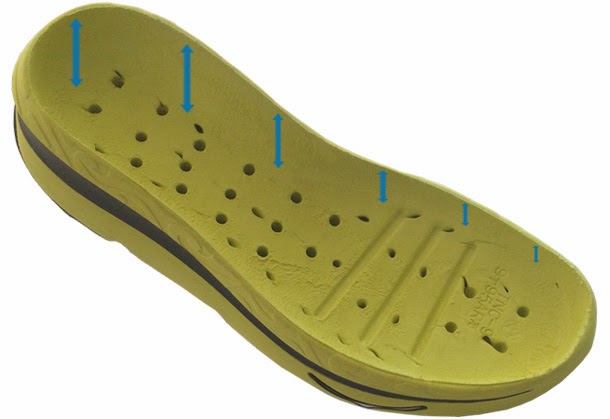
 Techy stuff! My biggest concern with this type of shoe, is the disconnect a stacked, thick midsole creates between your feet and the surface. The body relies on a certain amount of feedback from sensory nerves endings in your feet to properly support itself while running. I was afraid such sensations would be dulled or numbed. Well, Hoka has two main technologies that address this very issue. First, the Meta-Rocker midsole geometry (pictured above) creates a "guided" gait, which helps your feet take an efficient path from heel to toe. Second, the Active Foot Frame (pictured below) allows the foot to sit down in the midsole, not on top, to create a stable ride.

Let's be honest here, at first glance Hoka shoes remind people of a certain shoe that promised a nice tooshie and toned calves, i.e. the first reason why we were not going to carry Hoka. NO GIMMICKS! Little did I know, at the time, there is a lot of science, research and, most importantly, running behind the Hoka One One brand. The creators, in fact, dabble in ultra running a bit and wanted improved protection, especially down hill. So, instead of taking the design of a shoe and trying to improve it, they started from scratch and created something totally unique.
Now, when you see someone running down the street in Hoka, you have to take a second glance, which is the second reason we didn't carry the brand for a while. NO FADS! We just got through a trend of people running down the road in sandals, funky looking shoes, and even barefoot, that caused onlookers to rubberneck! We didn't hop onto that train, so we figured we wait a while to make sure this "maximal" movement had a little staying power. When iconic figures like Ken Harkless and Al Dimicco (Leukemia Society and Mercedes Marathon training coaches) put hundreds of miles on a pair of shoes and swear they "saved my running", we have to listen. Besides that, I've heard from many satisfied customers and see more and more of Hoka on the streets. Did we miss some sales? Certainly, but more important, we didn't get anybody hurt or put anybody in "fad" shoes.
OK, done with our No gimmicks, No fads buying philosophy! Here's what you need to know about our exciting new running brand! I'm in my second pair of Hokas right now. I put about 50 miles on a pair of the Stinson Tarmac and currently have about 30 miles on a pair of the Bondi 3, not coincidentally, the two styles we will carry for men and women. The very first question I get about the shoe. Is it heavy? The answer is a surprising NO! The Bondi 3 comes in at 10.3 oz. (8.8 oz. for women) which is highly competitive with other brands and styles. While the differences between the two styles are minimal, I did definitely notice the Stinson is softer, a tad heavier, and has a greater heel to toe drop (6 mm).
But the main attraction of the Hoka One One brand is the midsole volume, which can be up to two and a half times the normal midsole height. Traditional running shoes are *24mm in the heel and 12mm in the forefoot, which creates a 12mm offset*. The Stinson Tarmac is 32mm heel and 26mm forefoot. By soaking up all the impact forces generated by running on cement and asphalt, athletes can recover quicker and avoid injury easier!
Who should look at Hoka One One in The Trak Shak? Quite frankly, everybody, especially if you have had chronic knee, shin or hip injuries, are an ultra runner, trail or road, have an issue recovering from long runs or heavy mileage weeks, or need an extra couple of inches to FINALLY dunk a basketball! HA!
As for my experience in this new brand, I'll admit it again, I was wrong! It took me about 3 weeks to finally put them on my feet, but once I did, the shoes felt pretty good! In fact, my first thought after wearing them for the first time was, "Man, I wish I would have had these on during Statue to Statue!". For those of you who don't know, there are a LOT of hills in Birmingham's Statue to Statue 15K and the downhills are as bad, if not worse than the up! You can ROLL downhill in Hoka without having to worry about snapping a foot! I also was concerned I wouldn't be able to run very fast with that thick of a midsole, but my first few five milers in the Stinson were all under 7 minute pace, so there's that too! Fit wise, I did have to put a different insole in the Bondi to take up some volume. It's just a little wide for my feet!
Finally, I'll say this! For years, we have been telling folks to find grass or softer surfaces to run on! That is no easy task in our fair city! Problem solved! Throw 36mm's of foam between you and the ground, everything becomes a soft surface!!
*Fun fact for the day! Stack heights for running shoes happened because EVA (the foam used to build a midsole) only came in 12mm thick sheets, highly noticeable in the pic of my sweet, blue suede Pegasus 83's below!
Subscribe to:
Posts (Atom)